

The Real Thing
or How I Learned to Love Iris Season

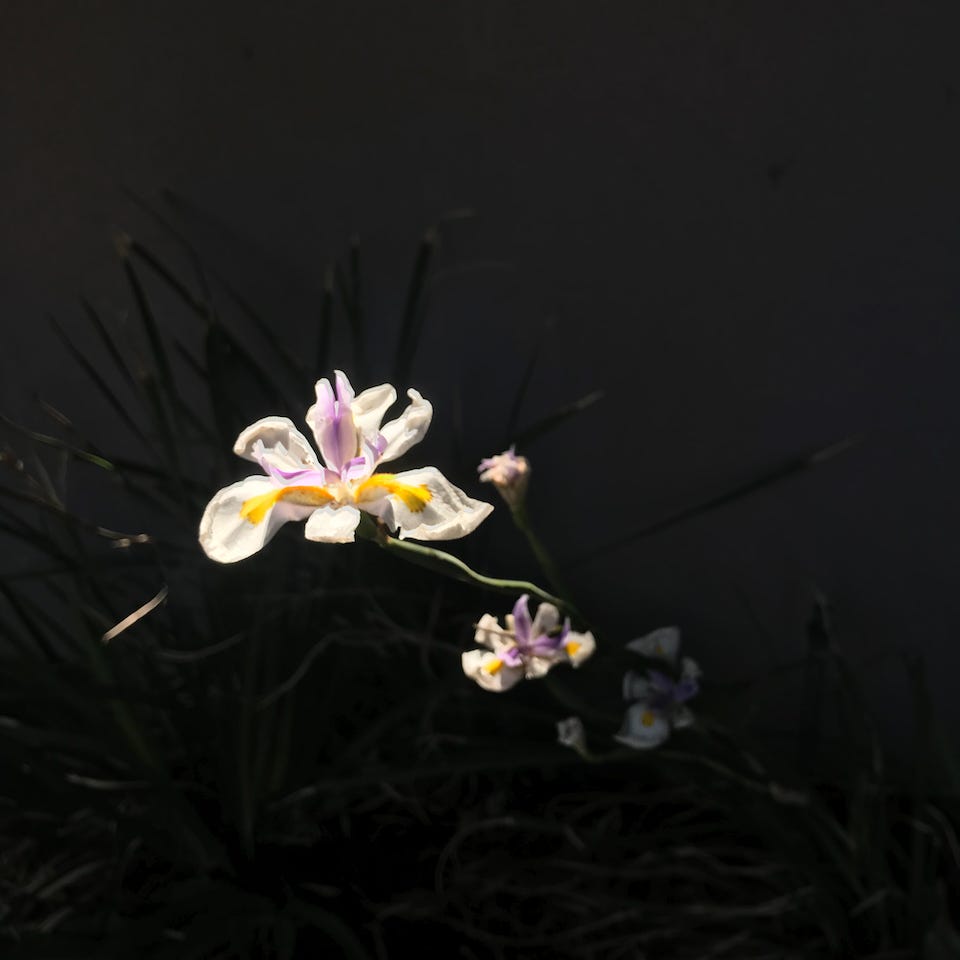
Zoom in
With the onslaught of generative AI, I think often how whatever creative career I’ve scraped together for myself might not exist soon, and it’s with that specific strain of undefined, nebulous urgency that makes me wonder how and if I should put it behind me and where I’ll go next (a convent maybe). I have many conversations with friends about this, and each one, whatever anecdotes and arguments may orbit, centers on how this technology is no longer a choice but an inevitability. I have to remember we were primed for this.
Zoom out
I can look back and see how the nexus of personal and global catastrophes in the first years of the pandemic and our collective fatigue made us ripe for all kinds of exploitation: being told daily that genocide is not a sin, but somehow inevitable; that all manner of brutality, dehumanization and depravity is not only inevitable, but necessary; that the only attainable progress is the unchecked acceleration of AI technology, its lone guarantee being the prioritization of profit at the expense of everyone who cannot reach the levers of power. Consent is no longer manufactured; what is required by the powerful is simply taken or imposed. Our planned obsolescence on a planet that will keep spinning into oblivion long after lifelessness. Accept it.
I find myself becoming less curious, more dismissive of most of what I see on screens. With no security in what’s real, I don’t risk my time or belief which both entail risking some kind of loss. That cute Pekingese puppy wearing a mushroom costume isn’t real. That 25-year-old woman your friend’s uncle talks to every night isn’t real. That prize-winning story is real, but it wasn’t written by a human being. It’s a faithless world out there in your phone.
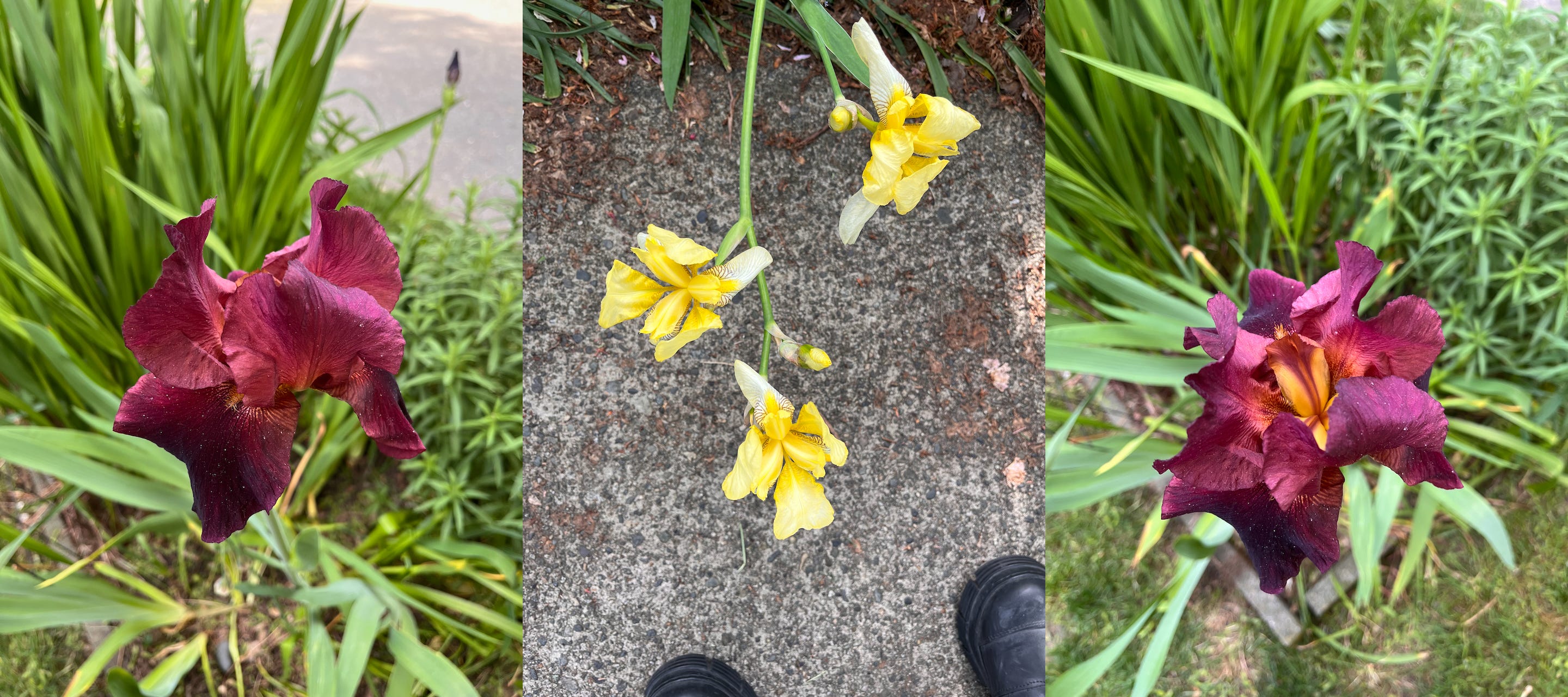
But then I go outside and I can accept many things for how they are. The inevitability of the natural world becomes a comfort. It’s a cycle (for now), not an end. And the irises have appeared.
I never paid attention to an iris until I went to Los Angeles, where they spring out of hot Valley sidewalks and almost seem to sway in the gasoline heat. It was their shadows I noticed first: long, immense. In the years since, I read Louise Glück’s The Wild Iris and it transformed my view of life Outside. Where I am now, the iris blooms are massive, ruffled and overflowing from their own depths like fabric, and I think, Oh, I get it now. Of course you’re famous. Yes, I’m captivated.
It took a while to get here.
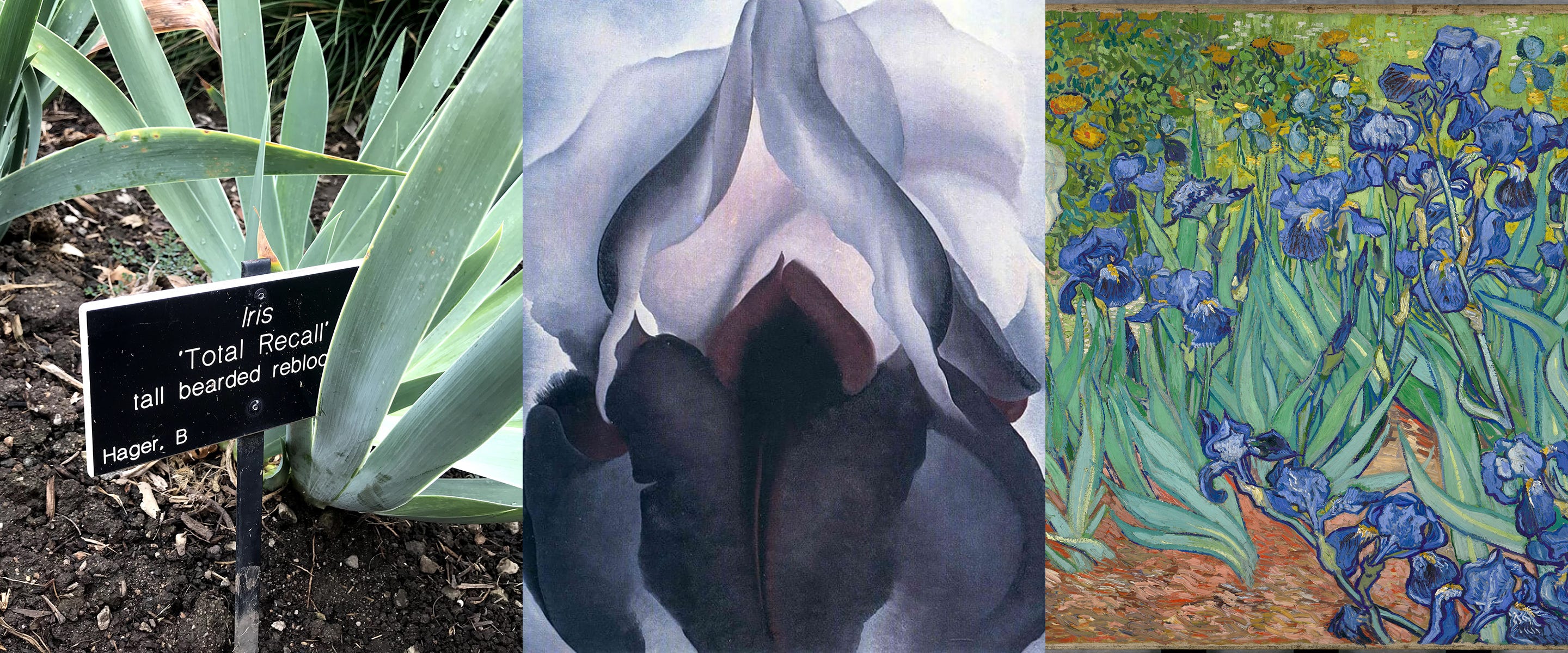
I went to The Huntington in San Marino once, but it was close to winter and all I saw were leaves, half-barren trees and placards for hundreds of iris varieties with names like “Daughter of Stars,” “Bernice’s Legacy,” “Total Recall,” tall bearded rebloomers, almost all flowerless. Like seeing empty enclosures at the zoo.
I never gravitated towards the irises of Georgia O’Keeffe. As a teenager I thought they just looked like yawning chasms of abstraction, nothing much to get lost in. Everyone talks about their likeness to female genitalia (all those folds, etc), and she famously begrudged this:
If I could paint the flower exactly as I see it no one would see what I see because I would paint it small like the flower is small. So I said to myself—I’ll paint what I see—what the flower is to me but I’ll paint it big and they will be surprised into taking time to look at it - I will make even busy New Yorkers take time to see what I see of flowers. I made you take time to look at what I saw and when you took time to really notice my flower you hung all your own associations with flowers on my flower and you write about my flower as if I think and see what you think and see of the flower —and I don’t.
The first and only time I visited The Getty, there was a small exhibition on Van Gogh’s Irises. Not the painting itself (which was annoyingly elsewhere and replaced with a print reproduction), but on how the museum’s “conservators and scientists have worked together to uncover the artist’s materials and working methods, and were able to examine how light has irrevocably changed some of the colors of the painting.” Basically, they put the canvas under a big x-ray to examine the chemicals used in the paint and found out the flowers were originally purple. I wasn’t moved because there wasn’t much there to move me, except maybe the context in which Van Gogh’s many irises were painted. (In the spring of 1889, after months of self-destructive psychic torment and the incident of the ear, he voluntarily entered an asylum in Provence. The asylum had a garden; his room, a window.)
Now, I look at O’Keeffe’s Black Iris and I think I see some of what she wanted those unsleeping Manhattanites to see. I look at reproductions of Van Gogh’s Irises and have an idea of the curative brightness he tried to depict from that enclosed asylum garden. I’ve encountered the real thing and it has changed everything after.
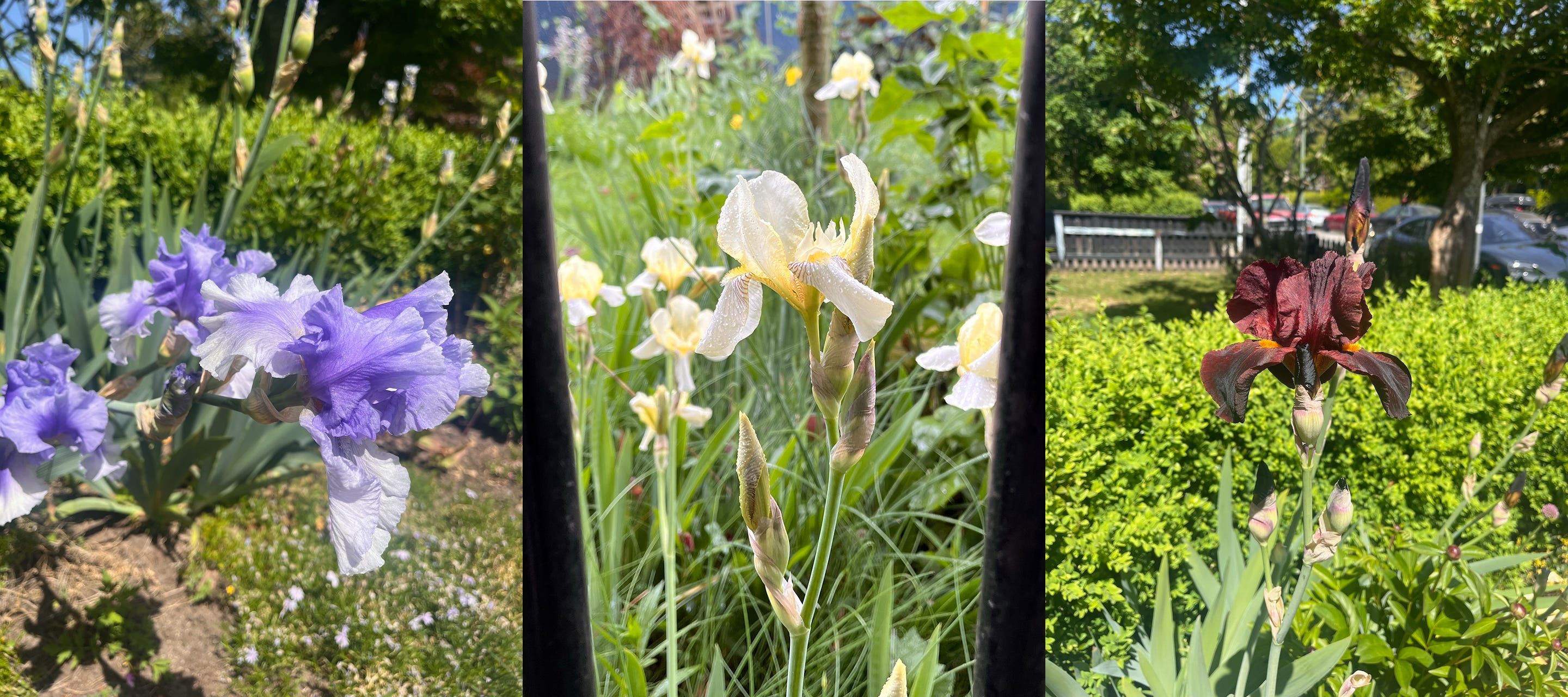
What I love about Outside in May: I find that I can still be curious about what I’ve already accepted so wholly. There’s so much to know, to find out. This type of knowledge doesn’t have to precede a judgement. It can augment your experience of a thing, a person, enhance the esteem you already hold. I want to know about you! is maybe the most romantic statement I can think of.
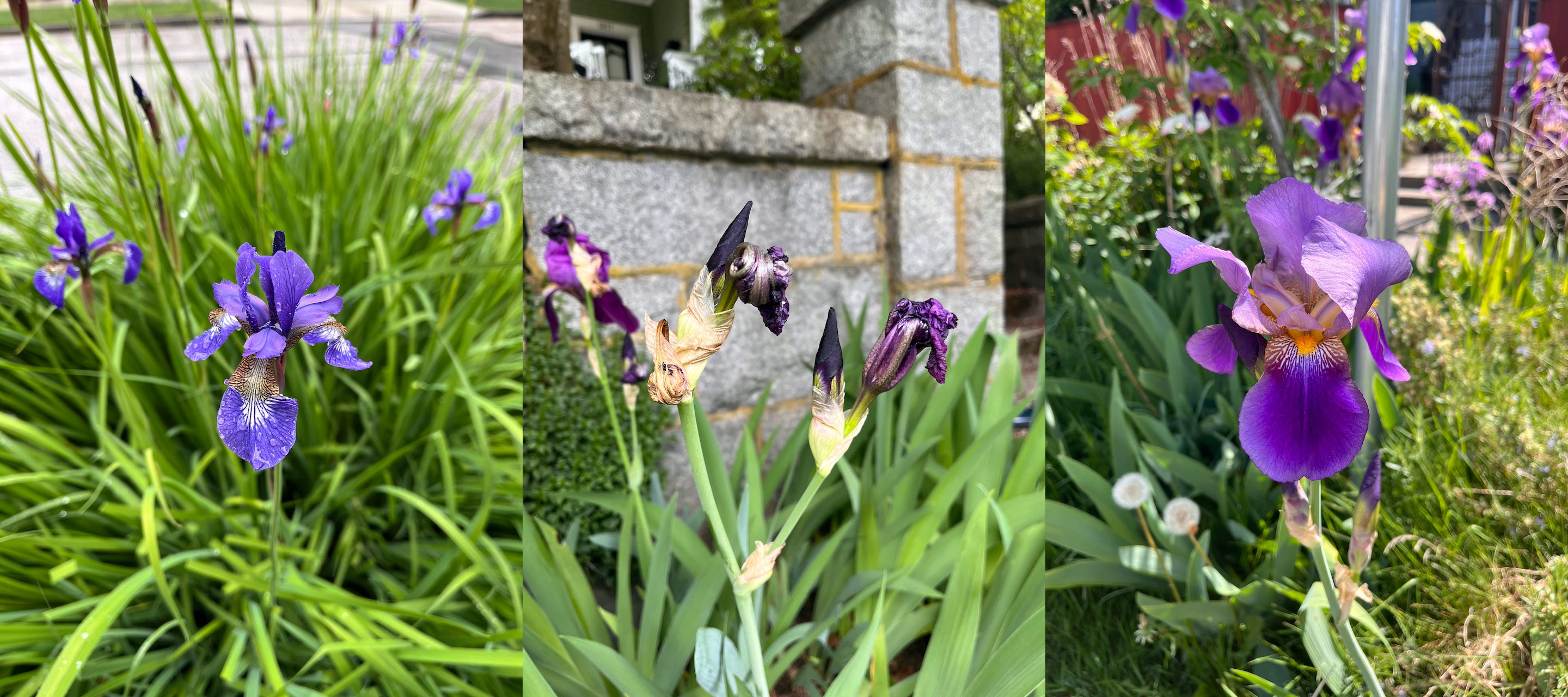
I can’t help myself: I’m interested in the velvet texture of a petal as it dies; two-dimensional leaves, like green shadows, splayed; the papery sheath of a bud and/or its withered translucence, so alike I cannot tell if one is coming or going and I accept my own ignorance in that.
All this to say, to irises, I never saw you until I saw you. I notice your petals are leaning to the left. You look a bit like an insect. You look like a Bird of Paradise. I see you’ve chosen to unfurl in this particular way. You are stooped so low, almost touching the curb. I won’t interfere. I believe in you.
When I feel like I’m losing my grasp of so many things—my passions, my time, my wits, my convictions—I think of a how a friend, going through a difficult time, said that what helped above all was having patience for oneself. I’m learning that this is an action and not a state. Ambivalence can be a kind of patience, as you hold the thread of tension and take time to unravel it. Acceptance is another; not a relinquishing or a submission—it’s standing still, but knowing that wherever you stand is solid earth.
There are so many days where everything feels angled against us, away from us, and I have no arsenal with which to push back or pull closer. Zoom in: I want to accept my shortcomings. And back out: it would all be easier if I could accept the ways in which we are told the world supposedly works. But I can’t. So I’m learning—practicing—that acceptance is not always coupled with inevitability, can often stand in opposition to it. Touch grass! they will tell you. Yes! And believe in it, too.
Love u ❤️